
The Adobe Marketing Mix: a focus on the product
A brief overview: from licensing to SaaS model
Adobe offers a variety of software for creating and publishing multimedia content, being a market leader in this area. Some of its core products include Photoshop, Illustrator, and Acrobat Reader.

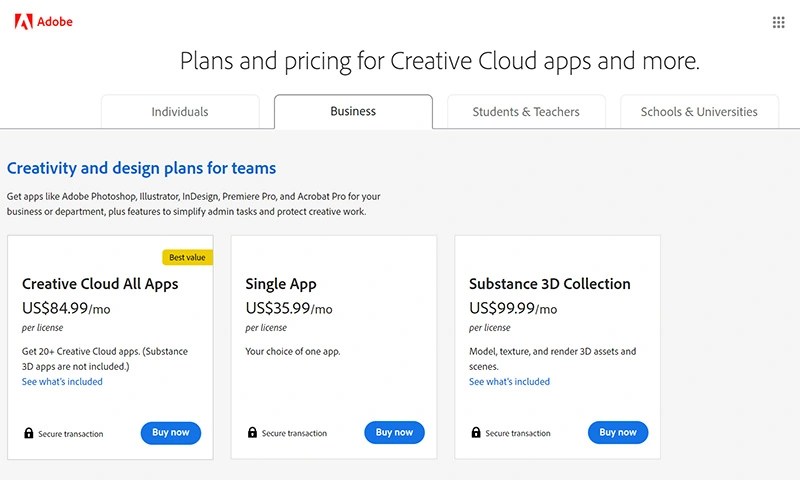
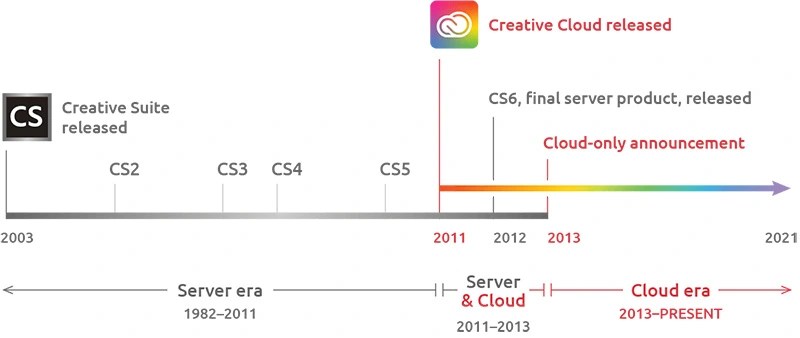
Before 2013, customers could buy software licenses. However, starting from 2012, Adobe shifted towards a “software as a service” model, like many other software companies did during the last decade. This change meant that Adobe adopted a subscription model, where users were no longer able to buy single licenses as they had done up to that point. Instead, they had to purchase a yearly subscription to software bundles.
The main subscription plans are Creative Cloud, Document Cloud, and Experience Cloud.
Users have the ability to access a huge library of resources with tutorials and presentations to learn about the products before subscribing to an annual plan, thus making a more informed choice. This opportunity, together with the numerous product demos, should optimize the purchasing process according to the “Software as a Service” logic.

Although the adoption of a subscription model has generated lively criticism from many users, it was made in response to the 2008 recession that had a significant impact on Adobe. The company experienced a 20% loss of revenue and had to lay off 8% of its workforce. During this period, Adobe observed the success of companies that had better resisted the crisis, including Salesforce, then a fresh name and a pioneer in adopting the SaaS model. Following Salesforce’s example, Adobe, along with many other companies, decided to embrace the subscription paradigm.
A history of acquisitions
Alongside this disruptive choice, Adobe’s history is studded with important acquisitions, starting in 1990, only eight years after its foundation. Some of its most relevant acquisitions include Macromedia, Omniture, Magento, Marketo, and, recently, Figma, which was the greatest deal of all.
To better understand Adobe’s product strategy, let’s consider the most recent evolution of the Creative Cloud, in relation to the web design software market.
The Creative Cloud is the bundle that best represents Adobe’s ambition to be a point of reference in the field of creativity software. This aspiration is reflected in every element associated with the brand, including its official website, advertising, offices worldwide, and the two main annual corporate events, Adobe Summit and Adobe Max.
That’s an aim that requires an outstanding ability to innovate.

The evolution of Adobe’s Creative Cloud
After the market entry of software dedicated to UI design, such as Sketch in 2010, Adobe released Muse. However, there was a delay in responding to the market, and it is possible that the company did not heavily invest in R&D in this area. Adobe Muse, launched in 2012, was no longer updated after 2018 and was effectively abandoned in 2020.
In 2016, Adobe tried again and launched XD. Yet, in the same year, Figma, a cloud-native and responsive digital design software, was also launched. Adobe XD never knew real success, despite the name and the promotional and distribution power of Adobe. On the contrary, it was recently removed from the Creative Cloud subscription page, alongside the entire UI & UX section.
At this point, in 2023 Adobe acquired Figma itself, confirming a product strategy that seems to introduce innovation mainly through acquisitions.
Adobe’s responses to market and technology changes
However, in recent years, the company also developed some products to respond to the growing entry of competitors on the market. One example is Adobe Express, an app that allows even a non-professional public to access the elementary functions of Adobe’s flagship products for carrying out various kinds of online advertising. This product seems like an answer to Canva.
In 2019/2020, following the spread of mobile devices, Adobe made streamlined versions of its products, such as Photoshop and Illustrator, specifically designed for iPads.
Today, the company is investing heavily in artificial intelligence, introducing numerous functions based on it in its main products and even giving them a name, Sensei. Firefly is the Adobe brand that includes creative generative AI models progressively coming to its products, such as “Text to image”, “Generative color”, “Generative fill” and many others.
From Adobe’s point of view, the AI tools should also bring a less expert audience closer to complex products such as Photoshop, enabling them to take advantage of these features to produce part of the artwork.
The attraction of a broader audience of users should fuel the content marketing strategy that has long characterized this company. In fact, Adobe has promoted its brand and products by emphasizing the creativity of its users through social media and the acquisition of community platforms like Behance.

At the same time, during its more than 40 years of activity, Adobe has established a truly extensive international distribution network, leveraging significant synergies with players such as Apple.
Despite Adobe’s solid profitability, the digital market is highly dynamic, and the coming years will be a real challenge for the company, especially in terms of its ability to innovate and stay ahead of the competition.
Beyond acquisitions, Adobe relies on its ability to attract talent thanks to competitive salaries, numerous benefits and incentives, properly paid internships, remote work policies, diversity & equity programs, an inclusive culture, and strong opportunities for professional growth.

Originally published on Medium, August 1, 2023
REFERENCES
Fig. 1. Adobe Photoshop (beta) x Adobe Firefly: Announcing Generative Fill. [Video cover]. Adobe. Available at: https://www.youtube.com/watch?v=IVTyLYupECI
[Accessed July 22, 2023]
Fig. 2. Creative Cloud plans and pricing available for business teams, in the US market. [Web page]. Adobe. Available at: https://www.adobe.com/creativecloud/plans.html
[Accessed July 23, 2023]
Fig. 3. A tutorial for learning how to create keyframe animation with After Effects on Adobe’s website. [Video cover]. Adobe. Available at: https://helpx.adobe.com/after-effects/how-to/keyframe-animation.html
[Accessed July 24, 2023]
Fig. 4. LaunchNotes (2021). The “Creative Cloud” launch timeline. [Online image]. LaunchNotes. Available at: https://www.launchnotes.com/blog/how-they-launched-it-adobes-cloud-transformation
[Accessed July 29, 2023]
Fig. 5. (2022). Adobe Summit 2022, Las Vegas. [Photograph]. It’s nice that.
Available at: https://www.itsnicethat.com/articles/adobe-max-2022-event-sponsored-content-200922
[Accessed July 25, 2023]
Fig. 6. Adobe (2023). Post showcasing an illustration created by an Adobe user. Instagram 22th of July 2023. Available at: https://www.instagram.com/p/Cu-GloFLFBe/
[Accessed July 24, 2023]
Fig. 7. (2022). Adobe supports employees’ life journeys and wellbeing. [Online image]. Great Place to Work®.
Available at: https://www.greatplacetowork.com/certified-company/1000005
[Accessed July 24, 2023]
Fast Company (December 02, 2022). Adobe at 40: The past, present, and future of creativity software’s enduring giant. [Online] Available at: https://www.fastcompany.com/90817765/adobe-at-40-the-past-present-and-future-of-creativity-softwares-enduring-giant
[Accessed July 30, 2023]
Wikipedia. List of acquisitions by Adobe. [Online] Available at: https://en.wikipedia.org/wiki/List_of_acquisitions_by_Adobe
[Accessed July 30, 2023]
Adobe (June 22, 2022). End of service for Adobe Muse. [Online] Available at: https://helpx.adobe.com/muse/kb/adobe-muse-end-of-service.html
[Accessed July 31, 2023]
The Verge (June 22, 2023). Adobe XD put on life support ahead of Figma acquisition. [Online] Available at: https://www.theverge.com/2023/6/22/23769586/adobe-xd-discontinued-shutting-down-figma-design-app
[Accessed July 31, 2023]
Adobe. The page presenting Adobe Firefly on the official website. [Online] Available at: https://www.adobe.com/sensei/generative-ai/firefly.html
[Accessed July 31, 2023]
 Eva De Crescenzo